

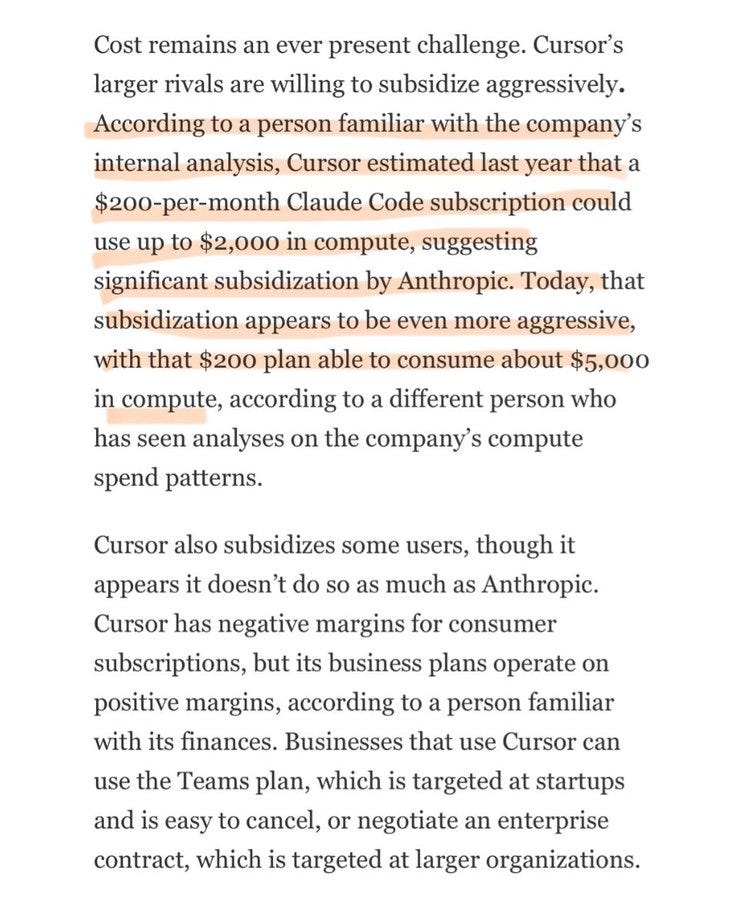
A recent Forbes article surfaced an internal analysis that Cursor did on Anthropic’s Claude Code. The numbers are crazy: last year, Cursor estimated that a $200/month Claude Code subscription could consume up to $2,000 in compute. Today, that number has reportedly ballooned to $5,000, meaning Anthropic could be losing $4,800 per month, per customer.
Anthropic can absorb losses like that because of how much they’ve raised - $64 billion in total. Faced with competition from OpenAI and Google, they feel compelled to subsidize their product costs to increase overall usage.
We’ve seen this dynamic before. Uber and Lyft rides used to be dramatically cheaper when the two were fighting for market share. Same story with food delivery, DoorDash and Uber Eats were practically giving away free meals to win customers.
Eventually, the subsidies stop and the prices normalize and the AI companies will eventually need to make money. That’s why ChatGPT is moving toward ads, and why Anthropic is doubling down on enterprise. The consumer pricing we’re enjoying right now may not be a permanent reality.
Maybe one of the core jobs of a future software engineer is just optimizing token usage. If you’re not precise in how you prompt and architect your AI workflows, you’re going to get burned when costs normalize. Sloppy prompting is cheap today, but it won’t always be.
Also, as costs rise, the advantage shifts toward whoever can afford to pay. Heavy token usage is already being priced into enterprise plans. Companies with deep pockets will be able to throw more compute at problems with better reasoning, longer context, and more iterations. While individuals and smaller teams may have to be surgical about every prompt.
There are a few reasons for some optimism. First, competition structurally keeps prices from going too crazy. Second, there’s always the open-source route: models you can run locally, on your own hardware, with no per-token bill. And third, the underlying costs may fall over time. Chips are getting more efficient, models are getting leaner, and there may still be major algorithmic breakthroughs ahead.